
The Study He Couldn't Say No To
When Brian Castellano's veterinarian mentioned that his ten-year-old Labrador mix, Hugo, might be eligible for a clinical trial at Colorado State University, Brian almost laughed. He was a civil engineer in Fort Collins, not a research scientist. He didn't think of himself as someone who enrolled his dog in experiments. But the vet explained what the trial was testing — a drug that had already extended the lifespan of mice by up to 25%, and that had shown early signs of improving heart function in aging dogs — and Brian found himself asking questions he hadn't expected to ask. Hugo had a slight heart murmur. He was slowing down on walks. He was healthy enough, technically, but he was old in the way that big dogs get old fast.
"I thought about it for a week," Brian said. "Then I thought about what it would mean if it worked. And I signed up."
Want more tips and stories like this? Dig into our Blog for the latest on all things dogs.
What Rapamycin Is and Why It Matters
Rapamycin is not a new drug. It has been used in human medicine for decades, primarily as an immunosuppressant prescribed after organ transplants to prevent rejection. What makes it relevant to aging research is what it does at the molecular level: it inhibits a cellular pathway called mTOR, which regulates growth, metabolism, and cellular aging. In laboratory mice, small doses of rapamycin have consistently extended lifespan — sometimes dramatically — and delayed or reversed a range of age-related disorders. The drug is the most reliably effective longevity intervention ever demonstrated in a mammal.
Read also: 500 U.S. Cities Banned Puppy Mill Sales. Eight States Passed Statewide Laws
The Dog Aging Project at Texas A&M and the University of Washington decided to find out if the same effect appears in companion dogs. TRIAD — first launched in 2021 — is described by researchers as "the first rigorous test of a pharmacologic intervention against biological aging with lifespan and healthspan metrics as endpoints to be performed outside of the laboratory in any species." That is a precise and significant claim. Every prior longevity experiment has been conducted in controlled laboratory conditions. TRIAD is running in living rooms and dog parks and veterinary clinics across twenty sites in the United States, on dogs who sleep on couches and go on car rides and eat their owners' leftovers.
Curious who's behind the matchmaking? Get to know our story on About Us.
The $7 Million and What It's Buying
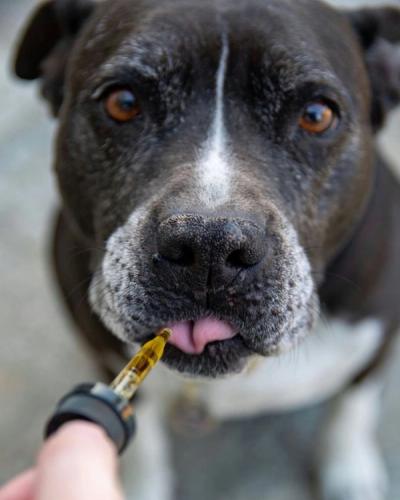
Researchers at Texas A&M received $7 million from the National Institutes of Health to expand TRIAD, which seeks to enroll 580 dogs total — with 170 enrolled so far and 20 active sites across the country. The trial is randomized and double-blind: half the dogs receive rapamycin in small oral doses once weekly, and half receive a placebo. Neither the dog owners nor the veterinarians at each site know which dogs are getting the actual drug until the trial concludes.
To enroll, a dog must be at least seven years old, weigh between 44 and 120 pounds, be spayed or neutered, and be in good general health — no diabetes, no thyroid disease, no active cancer. Each enrolled dog participates for three years, with visits every six months covering physical exams, blood and urine testing, echocardiography, ECG, and blood pressure monitoring. Activity monitoring devices are provided at no cost. All of this is paid for by the study.
Dr. Kate Creevy, co-principal investigator and professor at Texas A&M, said:
"We all want our dogs to live longer, healthier lives." Previous DAP studies have already shown that in small doses, rapamycin appears to improve cardiac function in aging dogs. As both people and animals age, the heart begins to stiffen, making it beat less effectively. Early data suggests rapamycin may counteract that stiffening — one of the most common and dangerous features of aging in mammals.
Read also: Top Dog Influencers Earn Millions. Tucker Budzyn Makes $40-60K Per YouTube Post
What "Healthspan" Means
One of the most important conceptual contributions of TRIAD is the distinction between lifespan and healthspan. Lifespan is simply how long a dog lives. Healthspan is how long it lives well — mobile, cognitively sharp, free from the chronic pain and organ decline that often define the final years of a large dog's life. Researchers are measuring both, but they are arguably more interested in healthspan. A drug that adds two years of suffering to a dog's life would be a failure. A drug that compresses the period of decline into a shorter window at the very end — or delays it significantly — would be a meaningful advance for dogs and, if the biology transfers, for humans.
The first dogs enrolled in TRIAD — two dogs named Zoe and Jack — have now completed their full three-year participation. Their data is in. The full results of the trial won't be public for some time, but the fact that the NIH invested $7 million to expand enrollment suggests the preliminary signals are worth pursuing.
Have a question or just want to say woof? Reach out anytime through our Contact page.
Why This Matters Beyond Dogs
Dogs age roughly seven times faster than humans, develop many of the same diseases, and live in the same environments. A ten-year-old dog experiencing cognitive decline, cardiac stiffening, and decreased mobility is a biologically reasonable model for a seventy-year-old human experiencing the same. If rapamycin reliably delays those changes in dogs — in real home environments, across a broad population — the implications for human gerontology research are significant.
Dr. Creevy told CBS News that studying dogs is not a workaround for human research. It is human research, one step removed, with a much faster biological clock.
Brian Castellano in Fort Collins takes Hugo in for his six-month checkup next month. Hugo still doesn't know he's in a clinical trial. He knows that the visits involve treats and that Brian always stays in the room. On the drive home from the last appointment, Hugo put his head on Brian's arm for the entire forty-minute trip. Brian didn't move.